






Key messages
- Recognise obesity as a disease, not just a risk factor
- Address obesity-related stigma to enable effective management
- Improve access to the entire continuum of prevention and treatment
- Generate intervention evidence relevant to decision-makers
- Integrate obesity policy into the EU Safe Hearts Plan
The Issue: Obesity is a chronic disease and a risk factor for serious comorbidities
Obesity is a chronic, complex, multifactorial, relapsing disease characterised by excess body fat that has detrimental health consequences (WHO, 2025a). It is estimated that half of the world’s adult population (or over 2.7 billion people) will be living with overweight (defined as a body mass index, or BMI, of 25 or more) or obesity (defined as a BMI of 30 or more) by 2035 (World Obesity Federation, 2023). In Europe, the prevalence of overweight and obesity in adults has increased by 22% relative to 1990 levels, and obesity by more than 75% relative to 1990 levels:
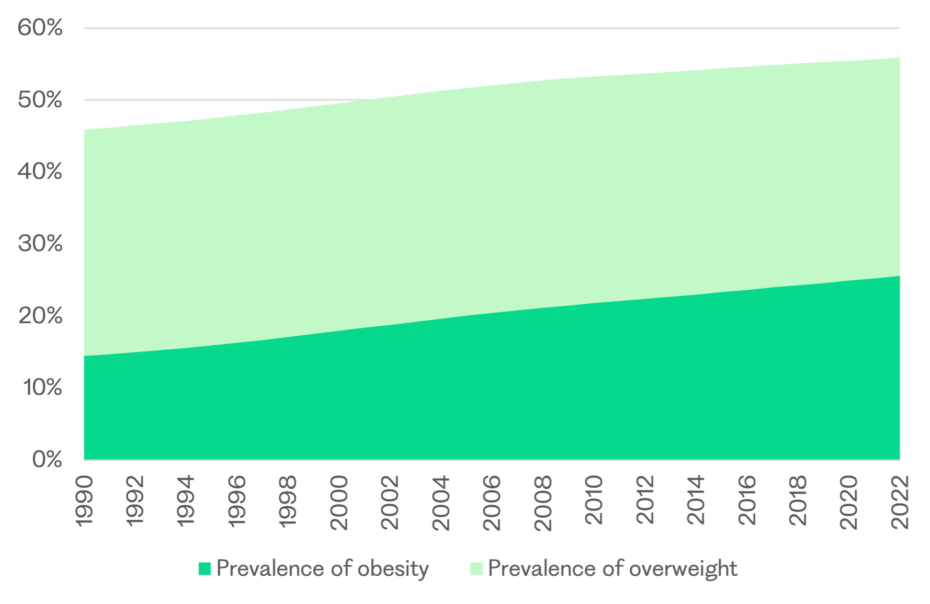
Prevalence of overweight and obesity in Europe
Source: (World Health Organisation Global Health Observatory, 2024)
Obesity is an important risk factor for serious and costly diseases including diabetes mellitus type 2, cardiovascular diseases, fatty liver disease (MASH), cancers, neurological disorders, chronic respiratory diseases, osteoarthritis, and digestive disorders, with many additional specific diseases discussed in wider literature.
To understand the consequences of this increasing prevalence, we quantified the direct and indirect costs associated with persons living with elevated BMI in eight European countries (UK, Germany, France, Italy, Spain, Ireland, Greece and Romania), which represent different demographics, health systems, and economic capacities. For our estimates of direct costs, we took a disease-based approach, calculating the portion of obesity-associated disease costs attributable to obesity. For indirect costs, we calculated time and productivity losses associated with obesity using studies estimating obesity’s effects on premature mortality, economic inactivity, absenteeism, presenteeism and informal care.
We find that the health and economic impacts of elevated BMI are substantial.
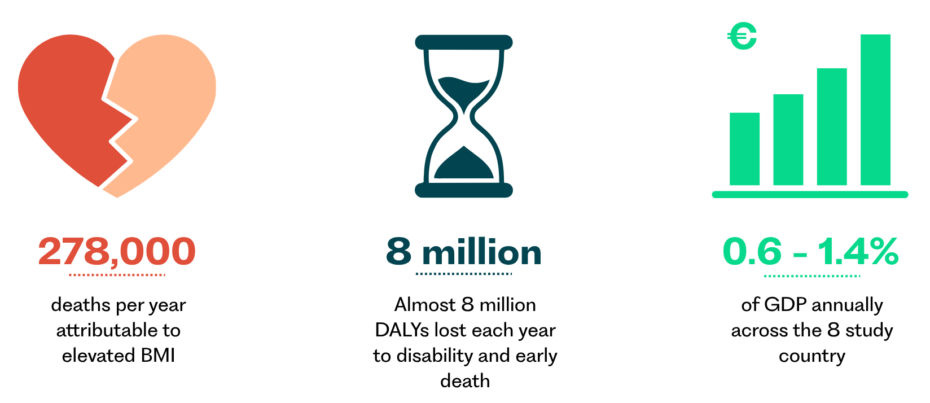
Across our eight study countries, elevated BMI is associated with 278,000 deaths and almost 8 million disability-adjusted life years(DALYs) annually.
Total annual costs (direct and indirect) of elevated BMI account for 0.6% to 1.4% of national GDP across our study countries, demonstrating its broad impact. The total annual economic impact of elevated BMI was greatest in Germany, at €55.2 billion (€662 per capita). The UK had the greatest share of indirect costs at 58%. Economic impact as a share of GDP was greatest in the UK and Greece, at 1.4% each.
Elevated BMI is a key risk factor in other non-communicable diseases (NCDs). Our estimates of the direct costs of elevated BMI were driven primarily by its impact on NCDs like diabetes mellitus type 2, chronic kidney disease, digestive diseases and cardiovascular diseases. Cases of these diseases attributable to elevated BMI accounted for the bulk of the health and economic burdens.
Indirect (productivity) costs accounted for between 18% and 58% of the overall economic burden of elevated BMI. This includes productivity losses due to premature mortality and economic inactivity, absenteeism, presenteeism, and lost time due to caregiving. This demonstrates that the impacts of elevated BMI go well beyond the healthcare system.
Although obesity has typically been seen as a health issue, these results demonstrate its substantial impact on the wider economy. This highlights the need for policy makers to think beyond the health sector and prioritise obesity as an economic priority, not just a health priority. These findings also conclusively demonstrate that – given the strong link between elevated BMI and the risk of many NCDs – any strategy to reduce the burden of NCDs must include a strategy to address obesity.
This Contract Research Report was commissioned and funded by the European Federation of Pharmaceutical Industries and Associations (EFPIA).