







Key messages
- Systemic barriers drive persistent underinvestment in prevention, including prioritisation of treatment over prevention, political and budgetary short-termism, misaligned incentives, and challenges of invisibility and attribution.
- Protecting, growing and diversifying funding sources can address key challenges; more innovative approaches can overcome multiple barriers simultaneously, although bring higher complexity and capacity requirements.
- Funding mechanisms must be combined and tailored to local and clinical contexts, underpinned by a long-term shift to a core approach to funding prevention.
- Addressing the systemic barriers to underinvestment in prevention is necessary to support in implementing effective funding mechanisms.
This research was conducted as part of OHE’s Change Initiative, which aims to advance innovative approaches to health economics and policy. This project was partly funded by unrestricted grant support from Eli Lilly and GSK.
Prevention of ill-health is an underexploited tool for protecting health systems and societies. It offers the potential to curb increasing demand for healthcare services, increase participation in education and the workforce, and reduce inequality. However, despite extensive evidence of the potential benefits, spending on prevention is routinely deprioritised.
Underinvestment in prevention is driven by a fundamental misalignment between the characteristics of prevention and the way health systems are governed and financed. Prevention delivers benefits over long time horizons, often outside political and budgetary cycles; benefits tend to accrue across multiple sectors, while funding decisions are made within siloed budgets, and based on narrowly-scoped investment frameworks; and success is defined by the absence of illness which makes outcomes difficult to measure, attribute and communicate compared to that of acute care. Under fiscal pressures, decision makers are therefore incentivised to prioritise visible, short-term treatment over long-term prevention, reinforcing a cycle of reactive spending on the treatment of disease which could have been mitigated with earlier intervention.
We set out a framework via which potential funding mechanisms for prevention can be grouped into three categories: Protect, Grow and Diversify. Protect includes funding mechanisms that prevent crowding out during budgetary pressures, when prevention competes directly with acute care priorities. Grow includes funding mechanisms that generate additional government funds that can be directed to preventative healthcare. Diversify includes funding mechanisms that mobilise new funding streams beyond government sources such as philanthropic or private capital.
Approaches to funding prevention
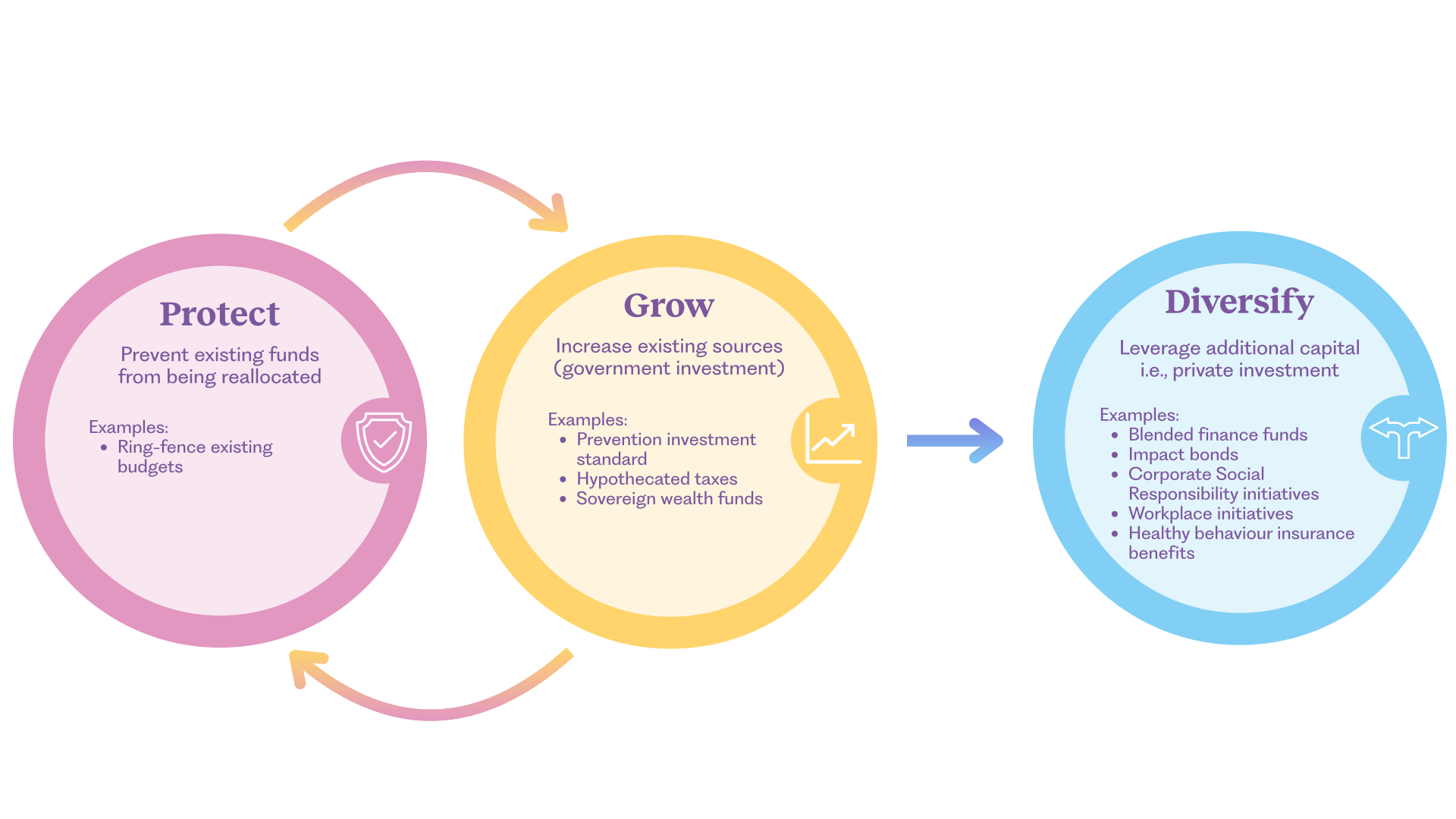
Analysis of each funding model confirms that the different models have the potential to overcome the challenges to funding prevention to varying extents. Approaches that protect prevention budgets can mitigate further erosion of prevention funding but cannot close the existing funding gap, while approaches that grow public investment can increase resources but remain vulnerable to reallocation without protection during periods of fiscal stress. Some approaches that diversify funding, such as blended finance funds (BFFs) and social impact bonds (SIBs), have the potential to overcome multiple barriers to funding prevention, by aligning incentives across sectors and tying funding to clear goals and outcomes respectively. However, such models are not universally applicable due to their complexity and cannot substitute broader structural reform. Our ‘checklists for success’ set out the conditions under which BFFs and SIBs can effectively mobilise private capital while delivering meaningful social impact.
A sustainable approach to prevention financing requires selecting a combination of mechanisms that are most appropriate for local contexts. Selecting appropriate funding mechanisms will entail considering the barriers overcome by each funding mechanism, as well as the practical implementation benefits and challenges of each approach. This should include considering the factors that will drive successful implementation. For example, for BFFs and SIBs we have determined this will entail considering factors related to the characteristics of the preventative intervention(s) being funded, the governance and data systems needed, the expertise needed to support a successful funding mechanism, and the funding mechanism’s agreement structure.
A key limitation to current approaches to funding prevention is that the funding mechanisms are typically utilised for individual or (small) groups of preventive interventions. They have not been used to date to support more general shifts towards systematic, multifaceted, comprehensive approaches to prevention. A core approach to funding prevention in each clinical or geographic context is still required. To achieve this, further work to address underlying structural barriers to sustained and comprehensive investment in prevention, such as the misalignment of incentives, is needed.