









Key takeaways
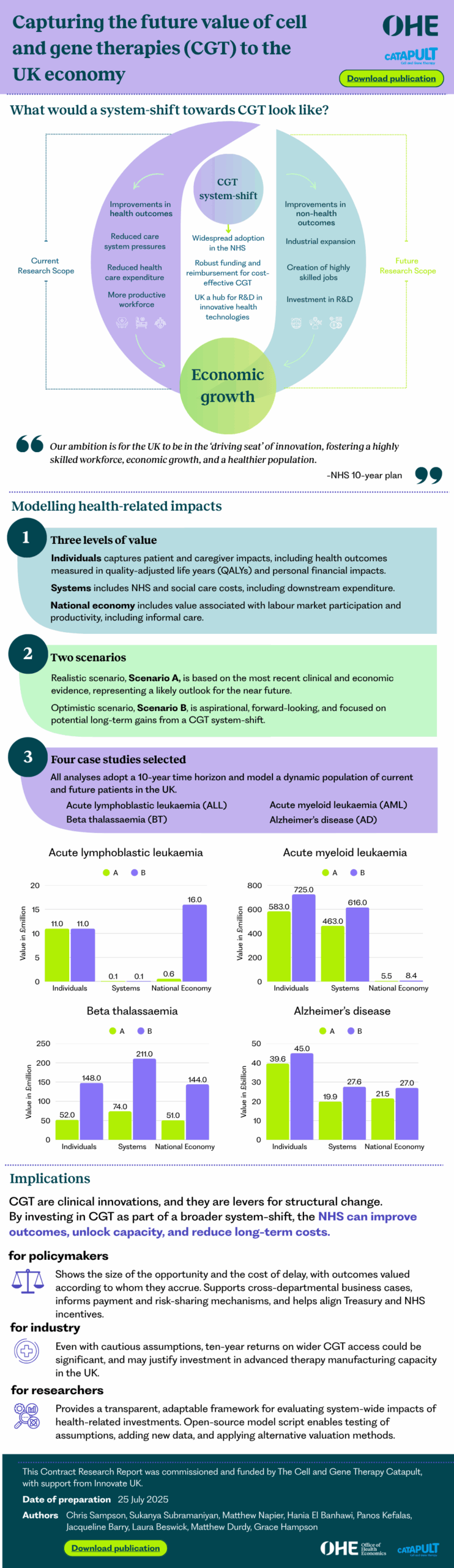
- Our research estimates that widening access to cell and gene therapies (CGT) in just four indications could create health benefits with a value exceeding £20 billion over 10 years, for individuals, systems and the UK national economy.
- We focused on four indications – acute lymphoblastic leukaemia (ALL), acute myeloid leukaemia (AML), beta-thalassaemia (BT), and Alzheimer’s disease (AD – and looked at the value generated by improvements in health outcomes which include increased productivity, reduced absenteeism, and enhanced quality of life for patients and caregivers.
- The full potential value of widening access to CGTs in the UK should also account for improvements in non-health outcomes such as job creation and investment in R&D. It is also important to recognise that CGTs are currently in Phase III trials for 36 indications, with many more in earlier phases, signalling the true scale of the pay-off to society.
Cell and gene therapies (CGTs) are moving rapidly from specialist trials to routine care: more than thirty products are already licensed worldwide and over two thousand are in clinical development. Their promise—a single intervention that can arrest or even cure previously intractable diseases—creates both opportunity and pressure for health systems.
The UK is well placed to capture the public value of a CGT‑driven system‑shift, realised through its existing life-science ecosystem and national health service. The objective of such a shift is to ensure that CGTs are routinely incorporated into care pathways and that the UK is established as a hub for research and manufacturing. Achieving this, however, requires decisions that go beyond the reimbursement of individual products: government and industry must coordinate investment in manufacturing capacity, clinical infrastructure, data systems, regulation, and workforce skills.
This report presents the first part of a whole-system economic framework designed to quantify the return on coordinated investment in cell and gene therapy. It considers the range of benefits resulting from health gains due to broader use of cell and gene therapies, including advantages for the health system and the wider economy (we refer to these as ‘health-related benefits’). By valuing costs and benefits across patients, care systems, and the wider economy—and aligning the analysis with HM Treasury’s Green Book—we offer an evidence base for academics, policymakers, and investors who must judge whether to invest in a CGT system-shift.
A new analytic approach
We adapt conventional approaches to decision analytic cost-effectiveness modelling, characterising value according to the level at which value is realised:
- Individuals captures patient and caregiver impacts, including health outcomes measured in quality-adjusted life years (QALYs) and personal financial impacts.
- Systems includes net NHS and social care costs, including downstream expenditure.
- National economy includes value associated with labour market participation, productivity, and informal care contributions.
The model is implemented as an open-source state transition template, populated with two evidence sets: Scenario A uses the most recent clinical and economic evidence relating to existing technologies; Scenario B explores an optimistic but plausible frontier. In contrast to individual technology assessments, the analysis accounts for current and future patient flows to identify value realised over a fixed period. A ten-year time horizon anchors the analysis to government spending review cycles, while an annual steady-state analysis provides estimates for long-term scaling. Four contrasting indications were selected to test the framework and provide an overview of the potential value of a system-shift in each area: acute lymphoblastic leukaemia (ALL), acute myeloid leukaemia (AML), beta-thalassaemia (BT), and Alzheimer’s disease (AD).
Main findings
Across the four case studies, widening CGT access yields large net societal benefits, even when only health-related outcomes are counted. Our findings demonstrate the substantial societal value of CGTs, derived from increased productivity, reduced absenteeism, and enhanced quality of life for patients and caregivers. CGTs are already in use in ALL, AML, and BT, and have small eligible populations. Despite small population sizes, we show significant potential for the realisation of value within a 10-year time horizon. For example, the value of CGTs to individuals with AML is £578 million, driven primarily by health gains. Meanwhile, the most significant value created in BT relates to healthcare cost savings, at around £74 million.
As shown in Table 1, under a conservative scenario (Scenario A), the additional value of widening access to CGTs is projected to create value between £20-40 billion across the four case study indications, depending on the category of value considered. AD dominates the aggregate because of its prevalence, but every indication is associated with significant returns in at least one category, even ALL, for which we modelled a small paediatric population.
Summary of case study findings for the value of a CGT system-shift
| VALUE OF SYSTEM-SHIFT* | |||||
| INDICATION | POPULATION SIZE | INDIVIDUALS | SYSTEMS | ECONOMY | MAIN DRIVER |
| ALL | 310 | £11 m | £0.1 m | £0.6 m | Longer survival in a small cohort |
| AML | 23,970 | £583 m | £463 m | £5.5 m | Durable remission reducing care needs |
| BT | 426 | £52 m | £74 m | £51 m | Transfusion independence |
| AD | 973,160 | £39.6 bn | £19.9 bn | £21.5 bn | Slower progression, reduced care burden |
* Estimates represent the incremental monetised value of outcomes over 10 years
Implications
For policymakers, the results signal the scale of the prize and the potential cost of delay. By presenting benefits and costs on a common monetary scale, and separating to whom value accrues, the analysis can support top-level and cross-departmental business cases that must satisfy both health and industrial strategy objectives. The analysis may also inform payment and risk-sharing mechanisms to help align incentives between the Treasury and the NHS.
For industry, aggregate demand signals matter. Even under conservative assumptions, the ten-year returns on wider access to CGTs could be substantial and may help justify the location of advanced therapy manufacturing capacity in the UK.
For researchers, the framework offers a transparent, adaptable starting point for evaluating other treatment paradigm-shifting investments requiring system-level change and warranting consideration by diverse budget holders. The template model script is publicly available, allowing researchers to interrogate its assumptions, incorporate emerging data, and test alternative valuation methods.
Next steps
Our approach integrates the broad societal perspective recommended by the Green Book, applies it consistently across four heterogeneous diseases, and provides model code and inputs for scrutiny. Nevertheless, the current report focuses on benefits related to four indications only (benefits arising from a whole system shift would be much larger), and only describes benefits derived from health improvements. It excludes industrial spillovers and revenue factors that could materially increase the benefit-cost ratio. The type and scale of investment required to realise a CGT system-shift are also yet to be identified. Subsequent stages of work will address some of these questions.
Our work supports the view of a UK CGT system-shift as a definable investment option rather than an abstract aspiration. Even a conservative reading of the health-related gains makes a compelling public value case; the inclusion of industrial and knowledge economy effects is likely to strengthen it further. The framework offered here provides researchers and decision-makers with a flexible and open-source tool for turning bold ambitions into evidence-based action.
The open-source version of the template model described in this report is available at https://github.com/Office-Health-Economics/CGT_template_model
This Contract Research Report, The value of cell and gene therapies to the UK economy, was commissioned and funded by the Cell and Gene Therapy Catapult, with support from Innovate UK.