


In this year’s Annual Lecture, Dr. Eduardo Banzon explored the challenges to financing prevention in healthcare, with a particular focus on his experiences at the Asian Development Bank. He also proposed a range of approaches to create incentives and overcome these barriers.
Key takeaways
- There are 6 main barriers to investment to prevention
- Re-framing the story is key to prevention financing
- Health taxes are a powerful tool to deliver prevention at scale
- Shift from passive spending to strategic purchasing to secure funds for prevention
- Using development loans to mobilise domestic resources for prevention
This year’s Annual Lecture was delivered by Dr. Eduardo Banzon, one of the world’s foremost experts on healthcare financing. With a career spanning medicine, academia, health insurance, and development banks, Dr. Banzon has experienced the challenges of health financing from every side of the table. Currently leading the Health Practice Team at the Asian Development Bank (ADB), Dr. Banzon offers a valuable perspective on the challenges of funding chronic diseases with fewer resources than developed nations.
Dr. Banzon opened his address with an introduction to the ADB’s work on financing health systems and infrastructure across Asia and the Pacific. He discussed the specific regional challenges of working with mostly middle income and upper middle-income countries (MICs and UMICs) facing the world’s most rapidly ageing populations and high instances of obesity. He then posed the question of how development banks can stimulate domestic financing for prevention.
The six barriers to financing prevention
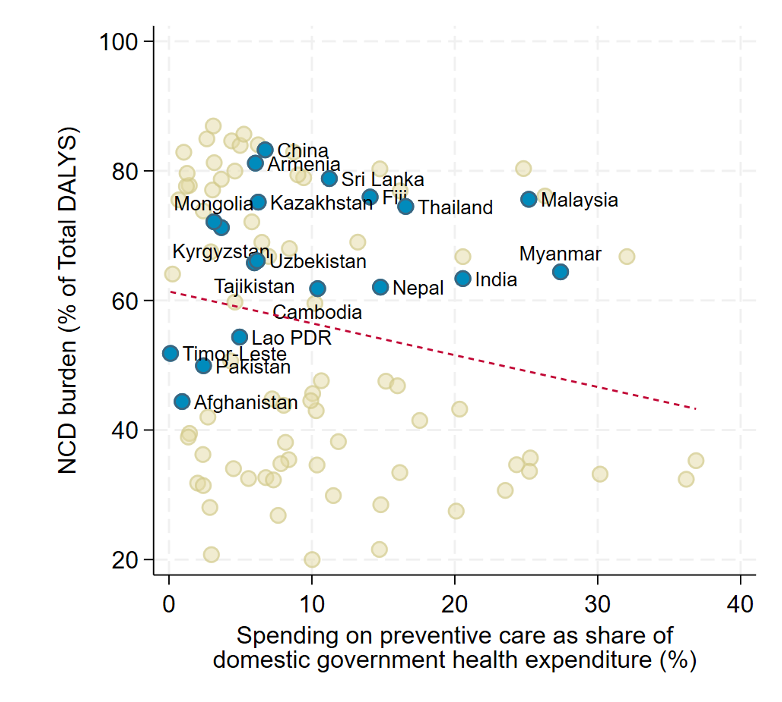
Despite the proven impact of preventive health measures in reducing non-communicable disease (NCD) burden, countries are still not investing enough in prevention. Dr. Banzon cited studies on spending across Central Asia and the Pacific that show countries are increasing curative care spending even when putting resources into prevention has led to a marked decline in NCD burden.
Figure 1: Countries with more resources allocated for prevention show a lower NCD burden, but do not increase prevention budgets (Source: WHO, ADB Health Observatory of Asia and the Pacific (HOAP))
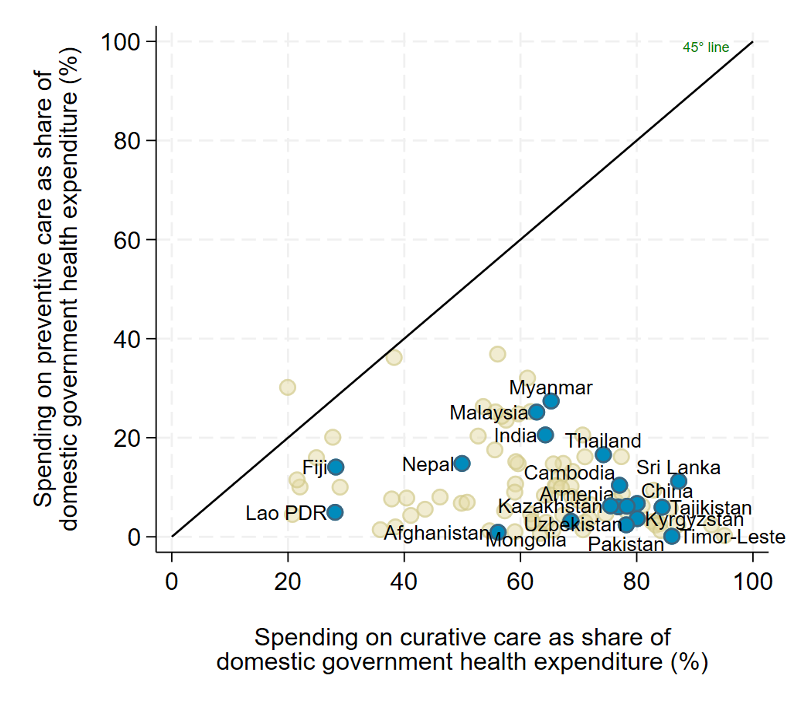
He identified six key drivers that contribute to this chronic underinvestment in prevention: the political gains of curative treatment, short-termism, budget silos, success invisibility, vested interests, and weak delivery pathways.
Each of these factors create incentives for treatment and curative interventions over prevention. Treatments produce quick political wins for governments, fulfil short-term goals, and work within yearly budget cycles which prioritise paying for inputs rather than outcomes. Since prevention requires long-term planning across sectors, and results are decades away, payers are not incentivised to invest in measures for which they are unlikely to receive the payoffs. Moreover, vested interest groups, such as tobacco and alcohol companies, pose significant opposition to prevention measures that may affect their commercial activities.
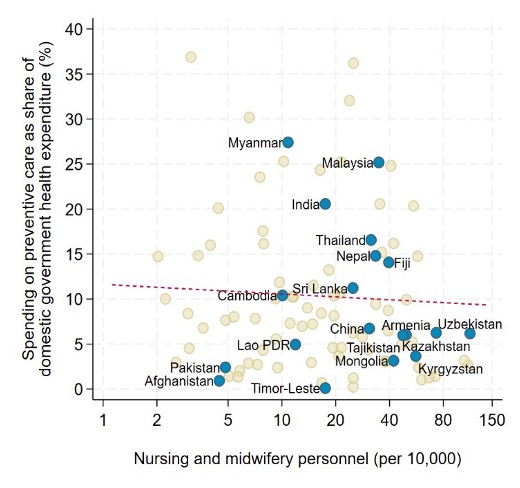
Weak delivery pathways, he argued, also pose a large barrier to investment in prevention. Workforces delivering care are trained to treat and cure conditions rather than to care and prevent. This is visible in countries across Asia and the Pacific where there is little correlation between the size of the nursing workforce, who deliver the majority of face-to-face care, and prevention spending. As such, this creates a misalignment between the work of healthcare professionals and prevention.
Figure 2: The size of the nursing workforce bears little relationship to government spending on prevention (Source: WHO, ADB Health Observatory of Asia and the Pacific (HOAP))
Interestingly, Dr. Banzon also spoke about the impact of aid architecture on prevention financing, particularly in low-and-middle income countries (LMICs). Vertical aid programs are designed to tackle specific problems which need a rapid response, such as outbreaks of TB or AIDS, providing grants with short time frames and narrow targets. By only tackling individual problems, these resources do not contribute to strengthening health systems or prevention.
Re-framing the story is key to prevention financing
Dr. Banzon argued that to build a financing architecture that prioritises prevention investment, health economists must create proposals that resonate with policymakers. As more studies continue to demonstrate the value of prevention, he suggested that learning how to negotiate and open dialogues with policymakers is critical to overcoming silos and collaborating with sectors outside of health.
Getting ministers across government departments to agree to increased prevention spending means convincing them that the benefits of such expenditure extend beyond health systems and have wider economic impacts. He drew attention to WHO Best Buys as an effective resource which highlights cost-effective interventions to address NCDs and also spoke to the ADB’s work in extending these arguments further. Dr. Banzon suggested that demonstrating how such prevention investment can create jobs and lead to GDP growth resonates more meaningfully with planning and finance ministers by relating preventive health back to widespread economic growth. Fostering a collective understanding of these benefits between government departments is a crucial step in securing prevention financing.
Health taxes as a tool to deliver prevention at scale
The lecture went on to explore practical mechanisms to help countries source prevention investment and divided these into three types: new sources for funding, better use of existing funds, and a hybrid approach.
Advocating for health taxes as a powerful tool for locating new funding, he argued that taxation is a useful means to reduce the prevalence of lifestyles which significantly contribute to NCDs and create new sources of revenue for prevention. A key example of this is the Philippines, which successfully raised $5 million USD in 2025 in health taxes with most of these domestic revenues earmarked for universal health coverage.
Dr. Banzon also suggested that health taxes were especially useful in LMICs. In these countries, it can be difficult to ring-fence budgets for prevention. Therefore, he argued that taxes not only reduce consumption and deliver population-wide results, they also generate new revenue for prevention. Although companies subject to taxes often argue that consumption taxes are regressive, he believed this issue is addressed when governments use levied funds to provide health coverage for the poorest people in society.
The shift from passive spending to strategic purchasing
The lecture then moved on to discuss how countries can better use existing funds to finance prevention measures. One example of this was conditional cash transfers that incentivise people to use health services. These measures currently exist for programmes such as antenatal checks and childhood vaccinations, but Dr. Banzon suggested similar approaches could be used to cover preventive instruments such as health checks and screenings.
Strategic purchasing was another key example which he explained always leads to increased prevention spending. Moving away from passive spending and towards strategic purchasing involves organising resource allocation according to population health needs and a willingness to pay for health outcomes and patient value over inputs and volume of services. Such purchasing reform rewards prevention and early disease detection over reactive treatments.
One means of initiating strategic purchasing is to establish health funds and insurance. Dr. Banzon pointed out that strategic purchasing is difficult in LMICs where budgets are rigid and require specific line items, whereas health funds allow for greater flexibility in how money is distributed, including increased prevention spending.
Using loans to mobilise resources for prevention
The third type of financing mechanism Dr. Banzon discussed was combining new sources of funding and better using existing funds, or a blended finance approach. He discussed how ADB applies this by thinking of loans as more than simply lending money, but as a means of enabling countries to mobilise resources for prevention.
One mechanism to achieve this was policy-based and results-based loans. He explained that ADB increasingly issue concessional loans to countries based on enacting certain policy reforms or achieving set targets. Such loans are more effective than investment loans at encouraging governments to make prevention a healthcare priority.
He also talked the audience through a planned ADB Healthy Asia Pacific for Prosperity, Inclusion, Employment and Resilience, or the HAPPIER Facility, an initiative which merges disparate resources to increase the available resources for healthcare reform. ADB aims to leverage millions in assistance money into billions of ADB financing into supporting trillions of domestic resources for healthcare investment. Rather than development funds and private investment sitting in silos, the HAPPIER Facility considers its financing as catalytic by layering different sources to increase the money available for systemic reform in healthcare systems. This planned initiative uses this composite funding model to embed prevention into health systems by investing in universal health care, digital health reform, and regional collaboration.
Conclusion
Dr. Banzon wrapped up his presentation by reflecting on the critical question at the heart of prevention in healthcare: how can we pay for it? Firstly, he recapped his proposals that health taxes and blended finance models were vital to increasing the funding available for prevention. He then called for a redesign of both aid and delivery systems to improve how funds are dispersed and how patients access preventive measures through primary care.
What links the various approaches in Dr. Banzon’s lecture is the need for collaboration and co-financing across sectors to successfully create a sustainable ecosystem for prevention investment. To build a new financing architecture to support preventive measures, governments, multilateral organisations, private sector actors and industry players must work together and apply different funding models to scale prevention effectively on a global level.
Watch on-demand
OHE’s Focus on Prevention
One of our charitable objectives is a commitment to educate and inform the public and policymakers about the most urgent issues in the healthcare sector. OHE’s Annual Lecture is an opportunity to highlight critical health challenges around the world, and to amplify the research and evidence that can inform how we address these questions.
Evidence overwhelmingly shows that investment in prevention is cost-effective and leads to improved health outcomes, a reduction in future healthcare costs, and wider economic benefits. Despite this, healthcare systems across the world continually fail to shift their focus from acute and reactive treatment, meaning interventions which could have a transformative impact on individuals and society remain underfunded.
At the same time, health systems globally are facing increased pressure from rising chronic disease rates, ageing populations and escalating costs, yet prevention continues to receive little funding.
Prevention in healthcare has been a key focus for OHE this year, including through the Change Initiative, which is a multi-stakeholder international forum bringing together leading organisations across industry, academia, and civil society to leverage their collective expertise. Through collaborative research, the Initiative aims overcome the systemic challenges of prevention financing and propose new frameworks to tackle underinvestment.
Graham Cookson, OHE’s Chief Executive, recently highlighted the importance of finding new ways to fund preventative healthcare in a piece for the Business Times. Pointing to Singapore as an example, he argued that societies with ageing populations must ensure longevity goals are matched with preventative approaches to extend years spent in good health, as well as adopt new financing instruments to distribute the costs of prevention measures.