



The latest EFPIA Patients W.A.I.T. Indicator 2025 Survey shows that patients across Europe are waiting longer for access to new medicines, with major differences between countries. Here we explain how to interpret the W.A.I.T indicators.
Introduction
The EFPIA Patients W.A.I.T. Indicator 2025 Survey report, the established benchmark for measuring market access to new medicines in Europe, was published in May 2026. It arrives at a time when the introduction and adoption of innovative medicines have become a matter of major importance. The US Most Favoured Nation (MFN) pricing policy, which references prices paid in comparator countries including some European ones, means that the speed and breadth with which European systems adopt new medicines will have repercussions globally. Adding to this, the first Joint Clinical Assessment (JCA) report under the new EU HTA Regulation was published in June 2026. The JCA introduces a centralised clinical assessment that will inform national pricing and reimbursement decisions, and is likely to reshape the pathway and timelines by which innovative medicines reach European patients. Within this context, understanding how we measure access in Europe is more important than ever — enabling us to track the impact of these significant policy developments on patients.
In this insight, we explain how to interpret the W.A.I.T. indicator and discuss the results from the 2025 Survey.
Benchmarking Market Access
The annual exercise provides a comprehensive series of indicators of market access for medicines in 36 European countries.
The indicators focus on the stage between a medicine receiving marketing authorisation (MA), granted by the European Medicines Agency (EMA) or the relevant national authority, and achieving market access in individual countries. Market access is recorded at the point when the medicine is recommended for use or formally funded through the public system.
Market access is measured across two dimensions:
- Rate of availability: the share of medicines in the sample that have reached the market in each country, and whether that access is unrestricted or limited to a subgroup of patients.
- Speed of availability: the number of days between a medicine receiving its initial MA and becoming available in each country.
The two dimensions are closely related. Countries with slower processes, sometimes taking two or more years, directly reduce their rate of availability, since medicines still moving through the access pathway are counted as unavailable.
How the W.A.I.T indicators measure market access
The sample covers medicines initially approved through the centralised EU licensing process, and tracks 36 European countries. The date of the initial EU MA is used to determine the year of inclusion in the sample. As the analysis is conducted at the molecule level, indication extensions for medicines already in the sample are reported only as a single, combined access status. For example, in the case of a New Active Substance (NAS) with three indications, if only two are reimbursed in country X, the molecule is recorded as having restricted access, rather than as having two available indications and one unavailable.
The indicator uses a four-year moving cohort to track changes in the rate and speed of availability. The four-year window was chosen to span the current range of market access times across the sample, from around five months to three years. Figure 1 illustrates the cohort years covered by the 2025 and 2026 reports.
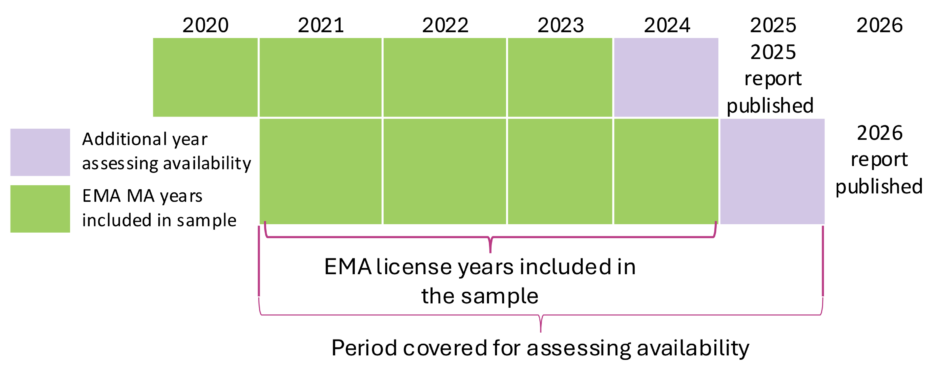
Figure 1: Sample time scope for 2024 and 2025 W.A.I.T indicator reports
A further consideration for speed of availability are the seven countries with separate licensing agencies, such as the Medicines and Healthcare products Regulatory Agency (MHRA) for England and Scotland. The W.A.I.T. report provides benchmarks from the date of the European license and local licensing, but uses the European date to determine the sample. This means that, for those countries with a local licensing system, non-availability may be determined by lack of a local license and not by the market access system. Based on this approach, a total of 168 medicines (NASs) were included in the 2026 report.
Market access processes (including pricing and reimbursement and Health Technology Assessments) differ from country to country, so measuring the rate, extent, and speed of availability requires careful interpretation. England illustrates the point: the accessibility date for a NICE-approved medicine is governed by the NHS funding directive, which gives local providers up to 90 days from the publication of positive guidance to fund the treatment, but for oncology medicines a shorter timeframe applies, mandating funding once the HTA decision is reached. A core strength of the W.A.I.T exercise is that it builds this kind of local intelligence into a common framework and analysis in support of meaningful cross-country comparisons.
What are the key findings?
Rate of availability
Across the 36 countries, the unweighted average rate of availability is 44%, just under one in two medicines in the sample. Of this, an average of 24% of medicines with an MA have achieved full access, 13% have limited availability restricted to a subgroup of patients, and the remaining 7% are available only privately or on a named patient basis.
Comparing these results with the 2019 report, the overall rate of availability has seen a modest decline, from an average of 54% in 2019. More significantly, the share of medicines with restricted availability has increased sharply, from 6% to 17%.
A further key finding is the persistent disparity across countries: the rate of availability ranges from 93% in Germany to 5% in Turkey, North Macedonia, and Bosnia and Herzegovina
The figure below presents the full results of the rate of availability by country (EFPIA, 2026).
Figure 2: Rates of availability by country by approval year (2021-2024)
Six of the countries in the sample are part of the MFN reference basket as defined under the Generating Cost Reductions for U.S. Medicaid (GENEROUS) model: Germany, France, Italy, Switzerland, the UK, and Denmark. All six report above-average rates of availability, with an average of 71%, compared to the overall sample average of 44%, as shown in the figure below (OHE analysis).
Figure 3: Rate of availability for European MFN GENEROUS countries
Speed of availability
The mean time from central MA to country availability is 607 days across the 36 countries, an increase of over three months compared to the 2019 report unweighted mean of 509 days. Variation across countries remains substantial, ranging from 158 days in Germany to 1,110 days in Romania. Full results are shown in the figure below.
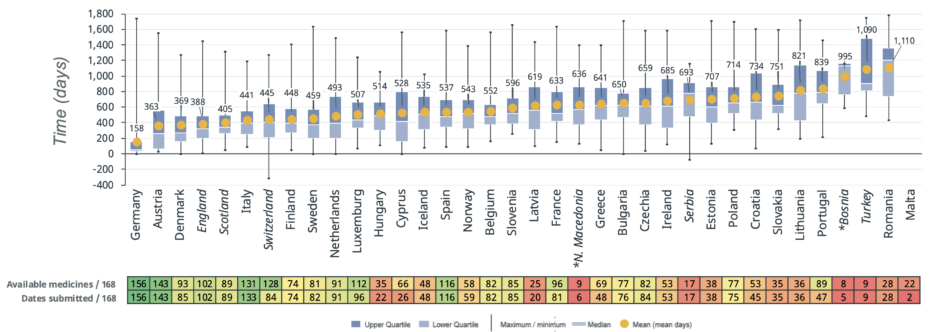
Figure 4: Speed of availability (days) by country by approval year (2021-2024). Source: EFPIA Patients W.A.I.T.
Indicator 2025 Survey
Among the six GENEROUS reference countries, five achieve a shorter time to availability than the overall mean, with France as the exception. At 406 days, the mean for these countries is below the overall mean of 607 days.
Figure 5: Speed of availability for 2026 W.A.I.T report for European MFN GENEROUS countries (days)
What the W.A.I.T. indicators miss and their future relevance
Focusing on NASs is appropriate for analysing regulatory approvals, as it aligns with the classifications used by regulatory agencies. It is less suited to access analysis, particularly for HTA systems that rely on cost-effectiveness analysis (CEA), where each indication is treated as a standalone intervention with its own comparators, evidence base, and value-for-money profile. This limitation is most acute for molecules with multiple indications: those in oncology and immunology together account for almost half of the medicines in the current report, representing 33% and 15% of the sample respectively (OHE analysis). For an indication-level approach applied to the UK context, see Darrow et al. (2025).
A related gap is the absence of analysis on free-dose combination therapies: regimens in which two or more agents are administered as distinct dosage forms, such as separate pills or infusions, and which are increasingly common in oncology. These therapies are particularly challenging to assess and reimburse, given the multiple manufacturers involved and the inherent difficulties of adding a new component to an existing treatment regimen (Towse et al., 2022; Towse et al., 2025). To illustrate the scale of this issue, during the period covered by the W.A.I.T. report, there were 33 NICE technology appraisals for oncology combination therapies, representing 20% of the 161 oncology treatments appraised by NICE in the same period (OHE calculations).
By 2030, all medicines will be assessed through JCA, covering both initial authorisations and follow-on indications. As the scope of JCA expands, conducting analysis at the indication level will become increasingly important, and the current NAS-based framing of the W.A.I.T. indicators will need to evolve accordingly. Since JCA assessments are structured around specific patient populations within each indication (as part of the selected PICOs), there is a further case for moving beyond molecule-level measurement towards greater granularity in how availability is recorded and reported.
In this context, one of the most valuable roles the indicators can play is to monitor whether, and to what extent, JCA narrows the gap in the speed of availability across EU member states. Several factors will influence this, including a proposed obligation under the EU pharmaceutical legislation for developers to launch in member states that request it, with loss of market exclusivity as the penalty for non-compliance.
Finally, in the context of most-favoured-nation (MFN) pricing policies, the WAIT indicators could serve as a tool to monitor the impact on access in affected countries. To support this, the 2025 report is accompanied by an analysis of regulatory approvals by the US Food and Drug Administration (FDA) and other agencies, such as those in China and Japan, to track whether the gap in approval timelines between the US and Europe widens, narrows, or remains stable over time. It is worth noting, however, that there is an inherent lag in the reporting cycle: the report published in 2026 covers medicines launched up to 2024, meaning the initial impact of MFN policies will not be visible in the W.A.I.T. data until the 2028 edition.
From measurement to policy
The 2025 W.A.I.T. Survey Report shows that, on average, just over half of new medicines reach patients across the 36 countries surveyed, with access times increasing since 2019 and significant variation persisting across countries. The indicators provide a well-established framework for tracking these trends, but their molecule-level design might need to evolve as JCA expands in scope.
Looking ahead, the W.A.I.T. indicators have a valuable role in monitoring the impact of two significant policy developments: the rollout of JCA and the effect of MFN pricing policies on European market access. The implications of both are likely to fall most heavily on the larger European markets, which currently achieve the highest rates and fastest times to availability. Tracking overall trends alongside country-level variation in future reports will give a read on how these changes play out in practice. Considering those results alongside approval and access trends in other markets, particularly the US, will be essential to understanding whether Europe is keeping pace.