





Key messages
- In‑silico technologies (ISTs) apply advanced computational and AI‑based modelling to complement, refine, or replace traditional testing across the medical product lifecycle and health technology development. UK CEiRSI is an international centre of excellence established to accelerate the development of ISTs and to support their regulatory acceptance and adoption across the UK, and ultimately across the world.
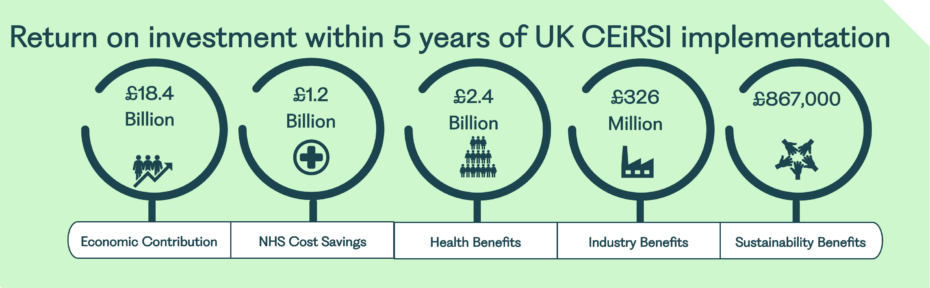
- With adequate funding, UK CEiRSI can act as a powerful catalyst for IST uptake, delivering substantial benefits within its initial five‑year implementation period. These include an estimated £21.9 billion contribution to the UK economy, £1.2 billion in NHS savings, £2.4 billion in population health gains, and £325 million in industry savings. These impacts are expected to generate further cumulative benefits well beyond the initial implementation phase.
- Beyond these quantifiable impacts, UK CEiRSI would accelerate wider IST benefits, including faster and more equitable access to treatments for more diverse patient populations, reductions in animal and clinical testing, and positive environmental and sustainability outcomes.
This Grant Research Report was commissioned and funded by the UK Centre of Excellence in In-Silico Regulatory Science.
In‑silico technologies (ISTs) refer to a broad group of computer-based techniques that allow for computational modelling and simulation including the use of data sciences and AI for science, and other computational science and engineering techniques (e.g. more mechanistic numerical modelling). While these approaches have been used in other domains for some time, their timeliness in the life sciences is derived from triple advancement in vast digital data availability, increased agency in computational techniques/infrastructures for science, and greater mechanistic understandings of many fundamental processes and factors affecting disease and product performance. Combined, ISTs and this triple-agency offer the potential to transform pharmaceutical and medical device development by replacing traditional laboratory, animal, and human testing with advanced digital modelling.
The UK Centre of Excellence for In-Silico Regulatory Science and Innovation (UK CEiRSI) aims to further ISTs’ development, regulation, and adoption in the life sciences sector in the UK and beyond. UK CEiRSI’s vision and activities are intended to deliver global impact by providing leadership in international harmonisation, as well as driving the UK as a global leader in ISTs’ regulation and adoption.
This report characterises the potential impact of ISTs on patients, health systems, and society as a whole. Furthermore, it identifies the key barriers to ISTs’ adoption and assesses the role and economic impact of UK CEiRSI in leveraging its unique position to address these barriers and maximise the benefits within the UK context.
A narrative review of both academic and other relevant literature was conducted to better understand the full potential positive impact of ISTs. The literature review highlighted primary areas of ISTs’ impact: the health system benefits, improved and new products and services and commercial benefits, patient welfare, economic efficiencies, and sustainability and ethical considerations. However, key barriers were identified that hinder adoption of ISTs, including their optimal integration in regulatory pathways, workforce skills gaps, legal and data access challenges, and social awareness and acceptance. UK CEiRSI is focused on overcoming these challenges.
On the basis of this literature review, an economic impact assessment of UK CEiRSI was performed, guided by the principles outlined in the UK Magenta and Green Books and informed by a social cost-benefit analysis. The assessment was based on the premise that UK CEiRSI is the only intervention in the UK specifically designed to address barriers to the adoption of ISTs and unlock their broader benefits for patients, the healthcare system, the associated industry sector, and the wider economy. A mixed-methods approach was applied combining evidence from existing literature with insights from an expert elicitation survey to estimate the potential value generated through its five-year implementation plan.
The economic analysis found that an adequately funded UK CEiRSI could act as a catalyst for ISTs’ adoption and deliver substantial health, NHS, industry and macroeconomic returns within five years. These include an estimated £21.9 billion contribution to the UK economy, £1.2 billion in NHS savings, £2.4 billion in population health gains, £325 million in industry savings, and £867,000 in ethical and sustainability savings in the form of reduced animal testing. Beyond these quantifiable impacts, UK CEiRSI has the potential to accelerate wider IST benefits, including faster and more equitable access to treatments for more diverse patient populations, reductions in animal and clinical testing, and positive environmental and sustainability outcomes.